I kept reading about “best practices” for Claude Code — subagents, context management, model routing — and kept wondering if any of it applied to how I actually worked. So instead of reading another guide, I built a tool that would just show me. Any Claude user can point it at their own history and get the same answer.
Every guide says the same things — delegate to subagents, vary the model, clear your context. Good advice, all of it. But reading advice and knowing whether you follow it are two completely different things. I didn't want another article. I wanted a mirror.
I went looking for the tool that would be that mirror. There are a couple of excellent ones already — ccusage for cost reporting, Claude-Code-Usage-Monitor for live burn-rate — and I'd recommend both. But neither answered the question I actually had, which wasn't “what did I spend”. It was “where are the gaps between how I think I work and how I actually work, and am I closing them or not?”
So I built the thing that would tell me. I called it Morpheus, because the whole point is that it coaches you — it doesn't just report on you. It reads straight from ~/.claude, so whatever it found in mine, it'll find in yours too.
The First Surprise: Half My Data Was a Lie
Before I could coach anything, I had to count it — so I wrote a script to walk my local Claude Code transcripts and add everything up. The first number it gave me was absurd. Nowhere close to what the built-in cost tools were reporting.
Turned out Claude Code rewrites the same assistant message into multiple transcript files every time a session gets resumed, branched, or auto-compacted. On my machine, roughly half of every usage record was a duplicate — some repeated ten times over. Any tool that just sums the files roughly doubles your real numbers without telling you.
I fixed it by deduping on the message ID before counting anything else. After that, my independent number and ccusage's number agreed to within 0.2% on the same data — which is about as good as two separately-written tools ever agree on anything.
Building the Coach, Not Just a Dashboard
Once the counting was honest, the real build started. Morpheus does three things, and I built them in this order on purpose:
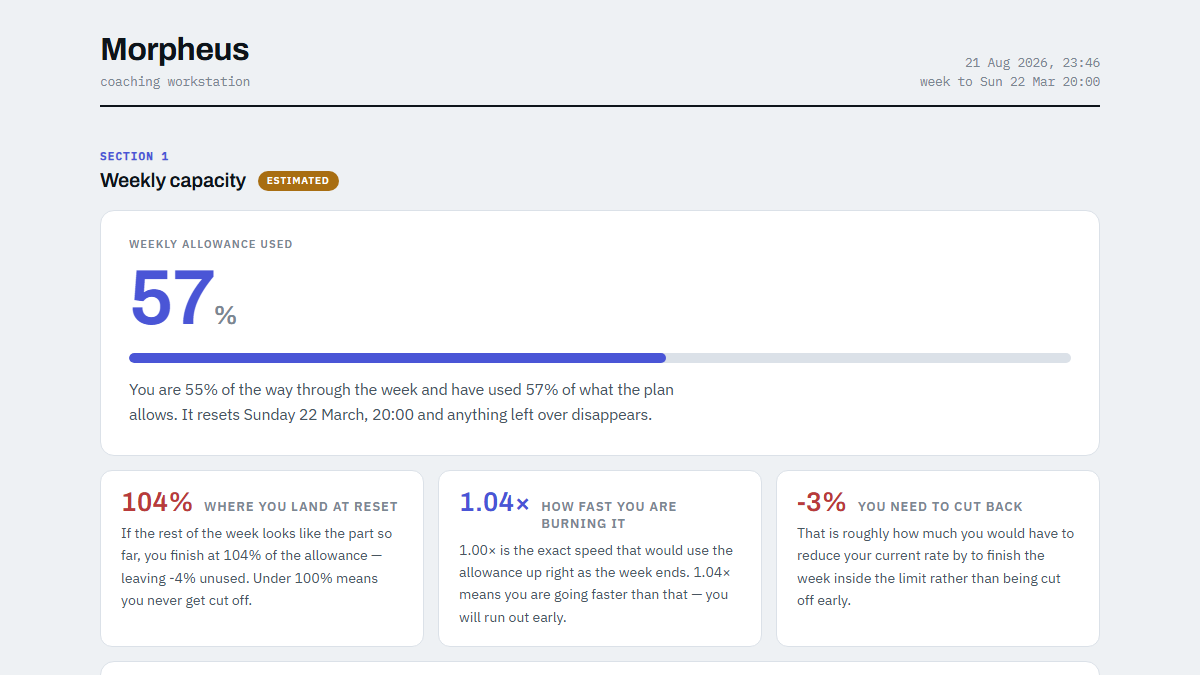
Weekly capacity tells me how much of my allowance is gone and what I'll land on at reset, broken down per project. The coaching review is the part I actually built this for — eleven rules that watch how I work: am I delegating wide searches to subagents, am I varying the model or defaulting to the heaviest one for everything, am I burning a quarter of my week in one marathon session. Every finding gets stated twice — once technically, once in plain English — because you shouldn't need to already understand context windows and caching to know what to fix.
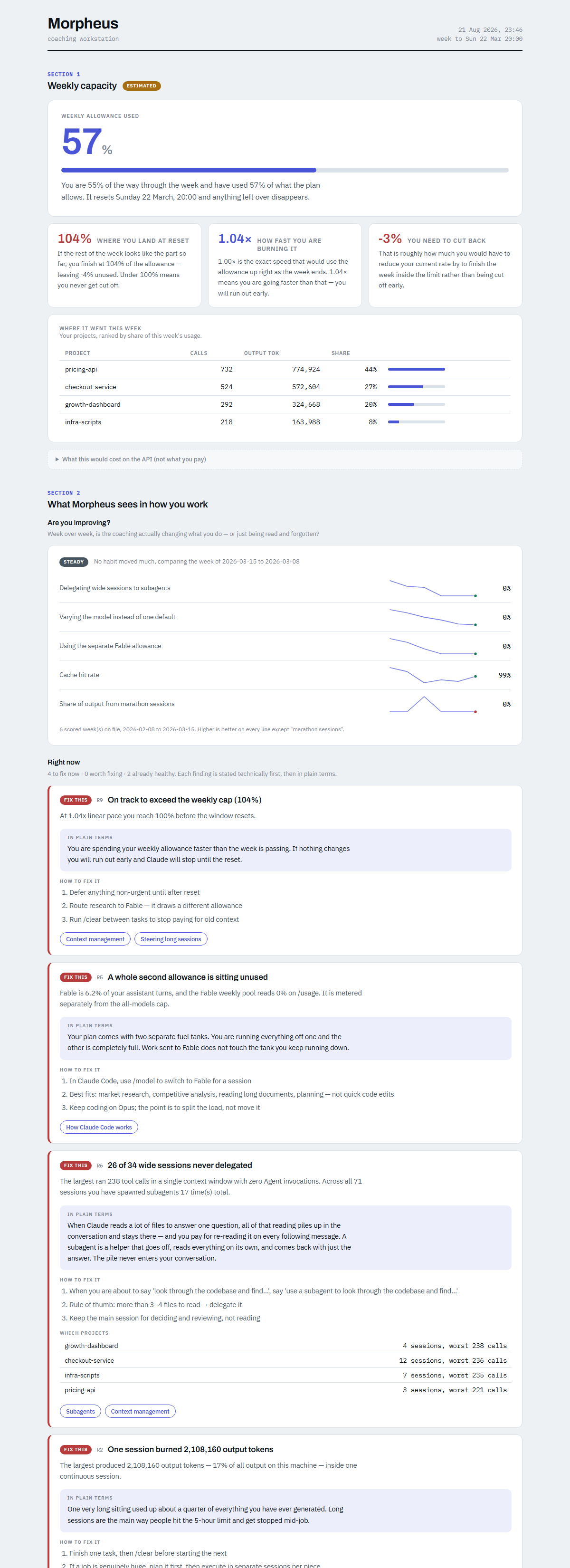
And then the adoption trend — the part I'm most proud of, and the one that actually stung a little. It scores five of those same habits every week and tells you flat out: improving, declining, or steady. The first time I ran it on real history, it told me my model variety had been falling for five straight weeks and my delegation rate had gone from a genuine habit to exactly zero. The coaching wasn't landing. It just took a chart to notice.
The Twist: Screenshotting My Own Dashboard Caught Three Bugs
Here's the part I didn't expect. I needed a clean screenshot for this exact post, so I built a demo-data generator rather than expose anyone's real project names — and the moment I actually looked at a rendered screenshot instead of trusting the code, I found three bugs live users would have hit:
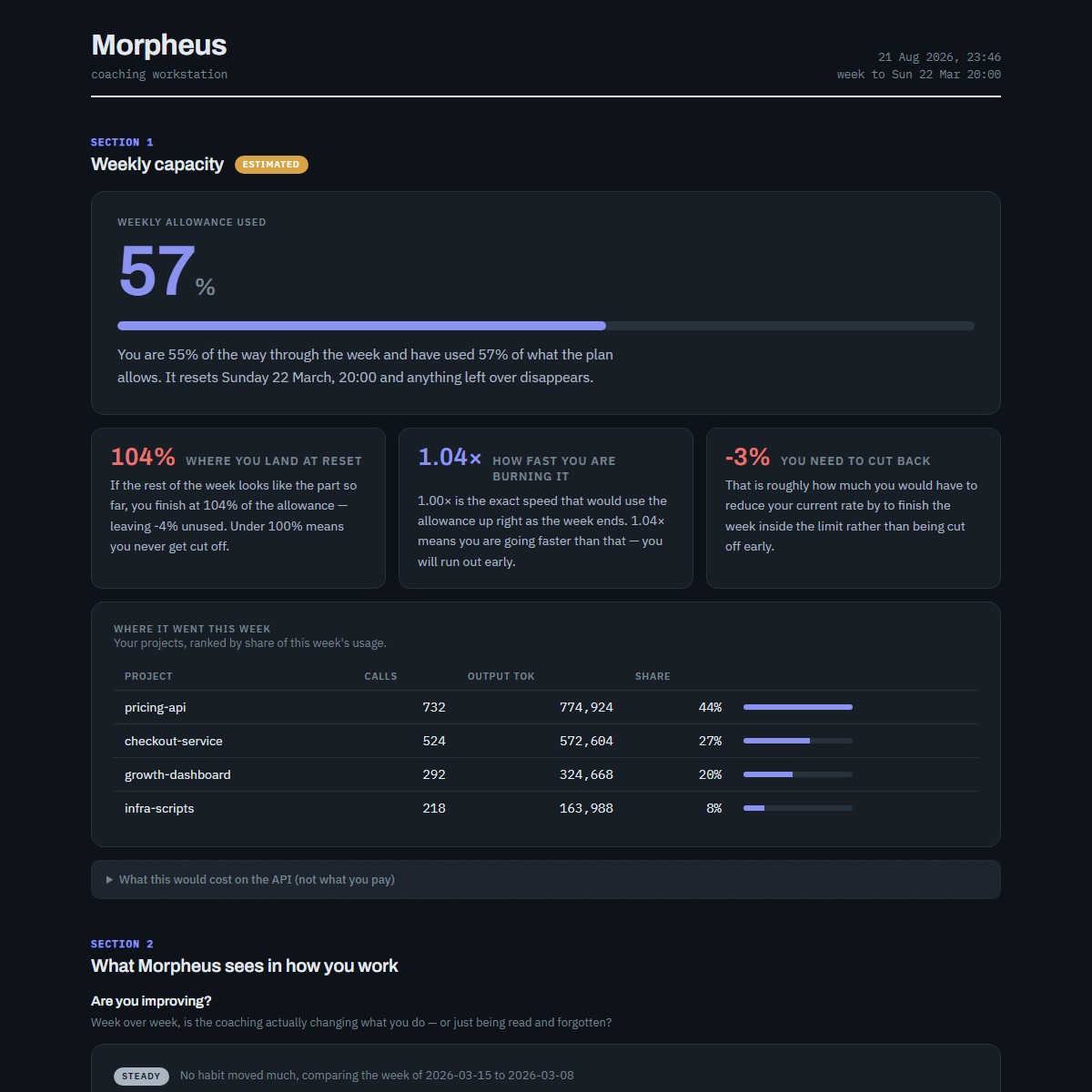
- Go even slightly over your weekly cap and the headroom card printed “+-3% room for more work” — a malformed number with copy that read as encouragement while you were actually over budget.
- A week where nothing moved got labelled MIXED, with a headline reading “0 improved, 0 declined” — technically true, deeply unclear. It needed its own steady verdict.
- The neutral status chip turned out to be white text on light grey — about 3.4:1 contrast, under the accessibility bar — invisible enough that I'd shipped it without noticing.
None of those would have surfaced from reading the code. They only showed up once I put the thing in front of my own eyes, the way a stranger actually would. Small lesson, worth repeating: build the screenshot before you trust the feature.
Why This Wins
- Local-Only: Every transcript stays on your machine. Nothing is uploaded, ever.
- Dedupe-First: Skip that step and every number you see is roughly double what actually happened.
- A Coach, Not a Counter: Eleven rules on how you actually work, not just how much you spent.
- A Free Second Tank: Most people on Claude Max don't realize their research-grade model draws a completely separate weekly allowance. Morpheus points at it directly.
- Works for Any Claude User: No two workflows look the same, so no generic guide can tell you where your gaps are. Your own transcripts can.